
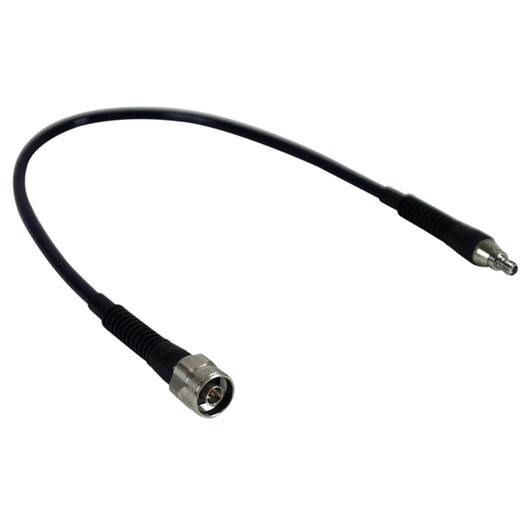
Standard 8.5 GHz phase stable test lead, female port, N(m) - SMA(f)
Precision You Can Trust
NABL-Accredited Calibration | Available on Request
The Pico TA337 Standard 8.5 GHz Phase-Stable Test Lead is a flexible 50 Ω RF cable designed for vector network analyzer and precision RF measurement applications. It features N-type male to SMA female connectors, a 600 mm length, low-density PTFE dielectric, loss of 0.85 dB at 8.5 GHz, phase stability of 2.8° at 8.5 GHz, and amplitude stability of 0.1 dB for repeatable high-frequency measurements..
- Detail
- Special Features
- Specification
The Pico TA337 Standard 8.5 GHz Phase-Stable Test Lead is designed for RF engineers, laboratories, production test teams and vector network analyzer users who require a flexible interconnect between an N-type test port and an SMA female measurement interface.
Pico Technology specifies the TA337 as:
- Order Code: TA337
- Performance Grade: Standard
- Connector Configuration: N(m) to SMA(f)
- Impedance: 50 Ω
- Length: 600 mm
- Maximum Specified Frequency: 8.5 GHz
- Construction: Flexible
- Dielectric: Low-density PTFE
- Diameter Over Jacket: 7.1 mm
- Gauge: 170 µm
The cable uses stainless-steel connectors and is designed to maintain controlled amplitude and phase behavior when flexed during RF measurements.
Designed for Vector Network Analyzer Measurements
The TA337 is an official recommended accessory for the PicoVNA 100 Series, including Pico’s 6 GHz and 8.5 GHz vector network analyzer configurations.
It is suitable for RF measurement workflows such as:
- S-parameter measurements
- Return-loss measurement
- Insertion-loss testing
- RF component characterization
- Filter testing
- Amplifier measurements
- Cable and interconnect analysis
- Antenna matching and tuning
- RF test fixture connection
- Network metrology
- Production RF testing
- Research and development
N-Type Male to SMA Female Configuration
The TA337 provides:
- Instrument-side connector: N-type male
- Measurement-side connector: SMA female
This connector arrangement is useful when a VNA or other compatible RF instrument uses an N-type interface and the device under test or accessory requires an SMA female connection.
The female SMA end allows direct connection to compatible SMA male DUTs, calibration devices, adaptors or other RF accessories.
8.5 GHz High-Frequency Performance
The TA337 is specified for use up to 8.5 GHz.
Pico publishes cable-loss values at two frequencies:
- 0.7 dB at 6 GHz
- 0.85 dB at 8.5 GHz
These manufacturer-published values provide a more useful representation of cable performance than generic terms such as "low loss."
Phase-Stable Performance
Movement or bending of an RF cable can change its electrical length, which may affect phase-sensitive measurements.
Pico specifies TA337 phase stability as:
- 2° at 6 GHz
- 2.8° at 8.5 GHz
Pico evaluates its phase and flatness performance by forming a straight cable into one complete 360° turn around a 10 cm mandrel.
This specification is particularly relevant in VNA measurements where cables may be repositioned between calibration and DUT connection.
Amplitude Stability
Pico specifies amplitude stability of:
- 0.1 dB
Amplitude stability indicates how much the measured signal level may change when the cable is flexed under the manufacturer’s specified test conditions.
For accurate network-analysis measurements, unnecessary movement of RF test leads after calibration should still be minimized.
Flexible Cable Construction
The TA337 is designed as a flexible RF test lead rather than a rigid or semi-rigid interconnect.
Pico describes its VNA test leads as robust and highly flexible, making them suitable for laboratory and production setups where devices under test must be connected and repositioned regularly.
Low-Density PTFE Dielectric
The cable uses:
- Low-density PTFE dielectric
This is part of Pico’s published cable construction specification and is used in its standard phase-stable VNA test lead design.
7.1 mm Jacket Diameter
Pico specifies the TA337 cable diameter as:
- 7.1 mm over jacket
- 0.28 inches
This provides a useful physical reference when planning test-bench routing or cable-management arrangements.
600 mm Cable Length
The TA337 has an official cable length of:
- 600 mm
- 60 cm
This should replace generic wording such as "standard length suitable for most VNA setups."
Stainless-Steel Connectors
Pico specifies its VNA test leads with stainless-steel connectors.
This provides a manufacturer-supported construction detail and is more precise than generic statements such as "high-quality connectors."
Standard vs Premium Pico VNA Test Leads
Pico provides both standard SMA and premium PC3.5 VNA test leads.
The standard family includes:
- TA336: N(m) to SMA(m)
- TA337: N(m) to SMA(f)
Premium alternatives include:
- TA338: N(m) to PC3.5(m)
- TA339: N(m) to PC3.5(f)
The TA337 is suitable where a standard SMA female measurement port is required, while the PC3.5 leads provide improved phase and amplitude stability for higher-precision measurement setups.
Typical Applications
The Pico TA337 is suitable for:
- PicoVNA measurements
- RF and microwave testing
- S-parameter characterization
- Return-loss measurements
- Insertion-loss measurements
- Filter testing
- RF amplifier testing
- Cable and connector measurements
- Antenna testing
- RF component verification
- Production test systems
- Network metrology
- Research laboratories
- Electronic design validation
Up to 8.5 GHz Operation
The TA337 is specified for RF measurements up to:
- 8.5 GHz
This matches the maximum operating frequency of the PicoVNA 108.
Phase-Stable Cable Design
Pico specifically publishes flex-related phase stability for the TA337:
- 2° at 6 GHz
- 2.8° at 8.5 GHz
This makes the cable suitable for phase-sensitive VNA measurements where test leads may need to move during DUT connection.
Controlled RF Loss
Published insertion-loss values are:
- 0.7 dB at 6 GHz
- 0.85 dB at 8.5 GHz
These specifications allow engineers to understand the expected cable loss at key operating frequencies.
0.1 dB Amplitude Stability
The TA337 has a published amplitude stability specification of:
- 0.1 dB
This supports repeatable amplitude measurements when the cable is repositioned under Pico’s specified flex test.
50 Ω Impedance
The TA337 is designed for:
- 50 Ω RF measurement systems
This supports use with standard RF, microwave and VNA equipment using a 50 Ω signal path.
N(m) to SMA(f) Connectors
Connector configuration:
- N-Type Male
- SMA Female
This makes the lead suitable for female-port measurement configurations using compatible SMA male DUT connections.
600 mm Length
The official cable length is:
- 600 mm
This provides sufficient reach for typical benchtop VNA measurements while avoiding unnecessarily long cable runs.
Flexible Construction
Pico specifies the TA337 as a flexible cable designed for repeated positioning in RF measurement environments.
Low-Density PTFE Dielectric
The cable uses low-density PTFE as its dielectric material.
Stainless-Steel RF Connectors
Pico specifies stainless-steel connectors across its VNA test lead range, providing a verified construction detail for the TA337.
7.1 mm Jacket Diameter
The cable measures:
- 7.1 mm
- 0.28 inches
over the outer jacket.
Standard Performance Grade
Pico categorizes the TA337 as:
- Performance: Standard
It is intended for working RF and VNA measurement setups requiring an SMA female port.
PicoVNA Recommended Accessory
Pico officially lists the TA337 as a recommended accessory for its PicoVNA 100 Series vector network analyzers.
Core Technical Specifications
| Specification | Details |
|---|---|
| Manufacturer | Pico Technology |
| Model / Order Code | TA337 |
| Product Name | Standard 8.5 GHz Phase-Stable Test Lead, Female Port |
| Product Type | Phase-Stable RF / VNA Test Lead |
| Performance Grade | Standard |
| Connector 1 | N-Type Male |
| Connector 2 | SMA Female |
| Connector Configuration | N(m) to SMA(f) |
| Impedance | 50 Ω |
| Maximum Specified Frequency | 8.5 GHz |
| Construction | Flexible |
| Gauge | 170 µm |
| Dielectric | Low-density PTFE |
| Diameter Over Jacket | 7.1 mm / 0.28 in |
| Length | 600 mm |
| Connector Material | Stainless steel |
| Recommended Equipment | PicoVNA 100 Series |
| Primary Applications | VNA measurements, RF testing, S-parameter measurements and component characterization |
RF Performance Specifications
| Frequency | Cable Loss | Phase Stability |
| 6 GHz | 0.7 dB | 2° |
| 8.5 GHz | 0.85 dB | 2.8° |
Amplitude Stability
| Specification | Value |
| Amplitude Stability | 0.1 dB |