
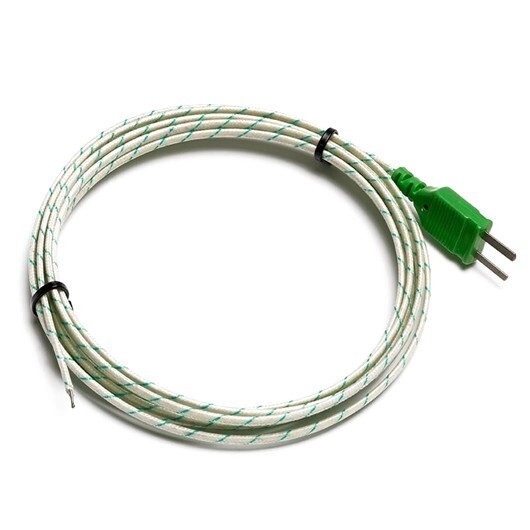
Thermocouple high-temp type K exposed tip, fiberglass insulated, 3 m
Precision You Can Trust
NABL-Accredited Calibration | Available on Request
The Pico SE061 High-Temperature Type K Thermocouple is an exposed-junction temperature sensor designed for oven, laboratory and demanding high-temperature measurement applications. It features a 3 m high-temperature fiberglass-insulated cable, 0.8 mm conductor rated to +1000 °C, fiberglass insulation suitable for continuous operation at +750 °C, and Class 1 Type K performance. Its exposed sensing junction supports responsive temperature measurement with compatible systems such as the Pico USB TC-08..
- Detail
- Special Features
- Specification
The Pico SE061 High-Temperature Type K Exposed-Tip Thermocouple, Fiberglass Insulated, 3 m is designed for engineers, laboratories, R&D teams and industrial testing applications that require reliable high-temperature measurement with additional cable reach.
Pico Technology identifies the SE061 as:
- Order Code: SE061
- Thermocouple Type: Type K
- Junction Type: Exposed
- Accuracy Class: Class 1
- Pico-Quoted Accuracy: ±1.5 °C
- Quoted Class 1 Range: −40 °C to +1000 °C
- Cable Length: 3 m
- Conductor Diameter: 0.8 mm
- Conductor Temperature Rating: Up to +1000 °C
- Insulation: High-temperature fiberglass / glass fiber
- Continuous Insulation Rating: +750 °C
- Primary Application: Oven and high-temperature measurements
The combination of an exposed junction, high-temperature conductor and 3 m cable makes the SE061 suitable for measurement points located farther from the thermocouple data logger.
High-Temperature Type K Measurement
The SE061 uses Type K thermocouple technology, one of the most widely used thermocouple types for engineering and industrial temperature measurement.
Pico specifies the Class 1 Type K performance across:
- −40 °C to +1000 °C
The thermocouple conductor itself is rated for:
- Up to +1000 °C
This high-temperature capability makes the SE061 suitable for demanding thermal measurement environments where standard fiberglass or PTFE-insulated thermocouples may not provide sufficient temperature capability.
Class 1 Type K Performance
Pico publishes the SE061 as a Class 1 Type K thermocouple with:
- Accuracy: ±1.5 °C
- Quoted range: −40 °C to +1000 °C
Pico thermocouples are manufactured to industry tolerance standards including:
- IEC 60584-2:1993
- BS EN 60584-1:2013
For high-temperature measurement systems, final system accuracy also depends on the data logger, cold-junction compensation, installation conditions and thermocouple condition.
High-Temperature Fiberglass Insulation
The SE061 uses high-temperature glass-fiber insulation.
Pico specifies the insulation for:
- Continuous operation at +750 °C
This rating should be distinguished from the +1000 °C conductor rating.
The complete thermocouple cable should therefore not automatically be described as continuously rated to +1000 °C.
0.8 mm High-Temperature Conductor
The SE061 uses a:
- 0.8 mm thermocouple conductor
Pico specifies this conductor for operation up to:
- +1000 °C
The thicker high-temperature conductor is a key difference between the SE061 and Pico's standard lower-temperature fiberglass-insulated thermocouple products.
Exposed-Junction Construction
The SE061 uses an exposed thermocouple junction, meaning the sensing junction is directly exposed to the measurement environment rather than enclosed inside a metal sheath.
This construction reduces thermal mass around the sensing junction and supports responsive measurement of changing temperatures.
Exposed-junction thermocouples are particularly useful for:
- Heated-air measurement
- Gas-temperature testing
- Oven atmosphere monitoring
- Thermal chamber testing
- Laboratory thermal experiments
Fast Response for Gas Measurements
Exposed-tip thermocouples generally provide a fast thermal response because the sensing junction directly contacts the surrounding environment.
This makes the SE061 suitable for compatible:
- Air-temperature measurements
- Gas-temperature monitoring
- Oven testing
- Heating and cooling studies
- Thermal process development
A specific numerical response time should not be added because Pico does not publish one for SE061.
Limitation in Corrosive or Oxidizing Liquids
Because the thermocouple alloys are exposed, exposed-junction probes should not be treated as general-purpose liquid immersion sensors.
For corrosive or oxidizing liquids, an appropriately protected or sheathed thermocouple should be selected instead.
This is particularly important in industrial environments where chemical exposure can damage the exposed thermocouple junction.
3 m Cable Length
The SE061 provides:
- Cable length: 3 m
Pico's high-temperature Type K family includes:
- SE059: 1 m
- SE060: 2 m
- SE061: 3 m
- SE062: 5 m
The 3 m SE061 provides additional reach for installations where the measurement point must be positioned farther from the TC-08 or other compatible thermocouple instrument.
Extended Reach for High-Temperature Setups
The 3 m cable can be particularly useful when:
- The logger must remain outside an oven or heated chamber
- The measurement point is located deep inside a test setup
- Multiple thermal zones need to be monitored
- The data acquisition system must remain away from process heat
- Cable routing requires additional distance
The extra cable length provides installation flexibility without changing the core SE061 high-temperature sensing performance.
Fixed High-Temperature Installation
Pico notes that high-temperature performance is particularly suitable when the thermocouple is fixed in position so the fiberglass insulation is not repeatedly flexed.
For demanding high-temperature applications:
- Keep the cable routing stable
- Avoid unnecessary movement at high temperatures
- Minimize repeated bending of heated fiberglass insulation
- Keep the cable away from mechanical abrasion
- Respect the +750 °C continuous insulation limit
This is more appropriate than describing the product as a highly flexible thermocouple for continuous movement at extreme temperatures.
Designed for Oven Temperature Measurement
Pico specifically describes this high-temperature thermocouple design as ideal for oven temperatures.
Typical oven applications include:
- Oven temperature profiling
- Heating-cycle measurement
- Cooling-cycle measurement
- Temperature-distribution studies
- Product heat testing
- Process development
- Oven validation
- Laboratory research
Thermal Chamber Testing
The SE061 can also support temperature measurement inside suitable thermal chambers.
Applications may include:
- Thermal cycling tests
- Heat-soak testing
- Product qualification
- Environmental testing
- Materials research
- Equipment validation
Multiple thermocouples can be positioned at different locations to evaluate temperature distribution across the test environment.
Heat-Treatment and Materials Testing
The high-temperature capability makes SE061 suitable for research and engineering applications involving:
- Heat-treatment experiments
- Materials testing
- Thermal process development
- Temperature profiling
- High-temperature R&D
- Industrial thermal validation
The measurement configuration should always remain within the temperature limits of the conductor, insulation and connected instrument.
Recommended for Pico USB TC-08
Pico Technology lists SE061 as a recommended accessory for the USB TC-08 Thermocouple Data Logger.
The TC-08 provides:
- 8 thermocouple channels
- Type K support
- Built-in cold-junction compensation
- Multi-channel temperature acquisition
- PicoLog software
- Long-duration temperature logging
Multiple SE061 thermocouples can therefore be used with available TC-08 channels for multi-point high-temperature monitoring.
Multi-Point High-Temperature Logging
When several SE061 thermocouples are connected to a multi-channel thermocouple logger, engineers can compare:
- Temperature at multiple positions
- Heating rates
- Cooling rates
- Thermal gradients
- Temperature uniformity
- Process conditions over time
This is useful for engineering validation and temperature profiling.
Thermocouple Aging at High Temperature
High-temperature operation can gradually change thermocouple characteristics.
Long exposure to elevated temperature, contamination or mechanical damage can affect measurement performance.
For demanding applications, good practice includes:
- Inspecting the exposed junction regularly
- Checking fiberglass insulation
- Avoiding contamination
- Checking electrical continuity
- Comparing measurements against a known reference where appropriate
- Replacing damaged or degraded thermocouples
Typical Applications
The Pico SE061 is suitable for:
- Oven temperature monitoring
- High-temperature air measurement
- Gas-temperature testing
- Thermal chamber testing
- Heat-treatment experiments
- Materials research
- Product thermal validation
- High-temperature laboratory testing
- Industrial process monitoring
- Engineering R&D
- Temperature profiling
- Multi-point TC-08 data logging
High-Temperature Type K Thermocouple
The SE061 is designed as a:
- High-temperature Type K thermocouple
Its conductor is rated for temperatures up to:
- +1000 °C
Class 1 Accuracy
Pico specifies:
- Accuracy Class: Class 1
- Quoted Accuracy: ±1.5 °C
- Quoted Range: −40 °C to +1000 °C
These values should replace the current unsupported ±1.1 °C or ±0.4% specification.
0.8 mm Conductor
The SE061 uses a:
- 0.8 mm conductor
The conductor is rated for:
- Up to +1000 °C
High-Temperature Fiberglass Insulation
The cable uses:
- High-temperature fiberglass / glass-fiber insulation
Pico specifies:
- Continuous operation at +750 °C
Exposed Junction
The sensing element uses an:
- Exposed thermocouple junction
This provides direct thermal contact with the measurement environment.
Responsive Gas-Temperature Measurement
The exposed sensing junction is suitable for applications where responsive air or gas-temperature measurement is required.
No numerical response time should be claimed unless supported by separate Pico documentation.
3 m Cable Length
The SE061 provides:
- 3 m cable length
The 3 m version provides greater installation reach than the 1 m SE059 and 2 m SE060 versions.
Ideal for Oven Temperatures
Pico specifically positions this high-temperature thermocouple construction for:
- Oven-temperature measurement
This is the strongest manufacturer-supported application statement for the product.
Suitable for Fixed High-Temperature Installations
Pico notes that high-temperature operation is particularly effective when:
- The thermocouple remains fixed
- The fiberglass insulation is not repeatedly flexed
This should be considered when designing long-duration high-temperature installations.
Industry Thermocouple Standards
The SE061 is manufactured to thermocouple tolerances referenced to:
- IEC 60584-2:1993
- BS EN 60584-1:2013
Recommended TC-08 Accessory
SE061 is officially listed by Pico as a:
- Recommended USB TC-08 thermocouple accessory
This provides manufacturer-confirmed compatibility for multi-channel Type K temperature logging.
SE061 vs Other High-Temperature Cable Lengths
| Model | Cable Length | Conductor | Insulation Rating | Conductor Rating |
|---|---|---|---|---|
| SE059 | 1 m | 0.8 mm | +750 °C continuous | +1000 °C |
| SE060 | 2 m | 0.8 mm | +750 °C continuous | +1000 °C |
| SE061 | 3 m | 0.8 mm | +750 °C continuous | +1000 °C |
| SE062 | 5 m | 0.8 mm | +750 °C continuous | +1000 °C |
Choose the cable length according to the required distance between the high-temperature measurement point and the data logger.
Technical Specifications
| Specification | Details |
| Manufacturer | Pico Technology |
| Model / Order Code | SE061 |
| Product Name | Thermocouple High-Temperature Type K, Exposed Tip, Fiberglass Insulated, 3 m |
| Product Type | High-Temperature Exposed-Junction Thermocouple |
| Thermocouple Type | Type K |
| Accuracy Class | Class 1 |
| Pico-Quoted Accuracy | ±1.5 °C |
| Quoted Class 1 Range | −40 °C to +1000 °C |
| Junction Type | Exposed |
| Conductor Diameter | 0.8 mm |
| Conductor Temperature Rating | Up to +1000 °C |
| Insulation Material | High-temperature fiberglass / glass fiber |
| Continuous Insulation Rating | +750 °C |
| Cable Length | 3 m |
| Recommended Application | Oven and high-temperature temperature measurement |
| Gas Measurement | Suitable exposed-junction configuration |
| Liquid Limitation | Not recommended for corrosive or oxidizing liquids |
| Tolerance Standards | IEC 60584-2:1993 / BS EN 60584-1:2013 |
| TC-08 Compatibility | Recommended accessory |
| Primary Applications | Oven testing, gas-temperature monitoring, thermal chambers, heat-treatment testing and high-temperature data logging |