
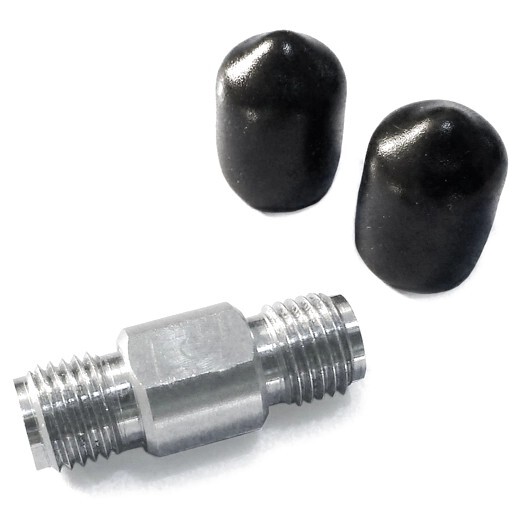
Standard test port adaptor SMA(f-f)
Precision You Can Trust
NABL-Accredited Calibration | Available on Request
The Pico TA343 Standard Test Port Adaptor is a precision SMA female-to-female RF adaptor designed to convert a male test port into a female test port. Rated for 50 Ω systems with bandwidth up to 18 GHz, it enables connection to SMA male devices under test in VNA, RF and microwave measurement setups. The TA343 is particularly suited to PicoVNA applications requiring flexible DUT gender interfacing and calibrated high-frequency measurements..
- Detail
- Special Features
- Specification
The Pico TA343 Standard Test Port Adaptor SMA(f-f) is designed for RF engineers, laboratories and vector network analyzer users who need to change a male SMA test port to a female SMA test port.
The adaptor has SMA female connectors at both ends, allowing equipment with a male test interface to connect to devices under test that also have male connectors.
Pico Technology identifies the TA343 as its ADA-STD-FF standard test port adaptor. Current PicoVNA documentation specifies the standard SMA adaptor family with a 50 Ω impedance and bandwidth up to 18 GHz.
SMA Female-to-Female Gender Conversion
The primary purpose of the TA343 is straightforward gender adaptation.
It can be used to:
- Convert an SMA male test port to an SMA female test port
- Connect SMA male DUTs to compatible male-port measurement setups
- Adapt VNA test ports for different DUT connector genders
- Reduce the need to maintain separate test leads for every connector configuration
- Support single-port and two-port RF measurement configurations
This makes the adaptor particularly useful in laboratories where different devices under test may use different SMA connector genders.
50 Ω RF Measurement System
The TA343 belongs to Pico's 50 Ω standard SMA test port adaptor range.
Maintaining the correct characteristic impedance is important in RF and microwave test systems because impedance discontinuities can introduce reflections and measurement errors.
The adaptor is therefore suitable for compatible 50 Ω RF measurement paths, including:
- Vector network analyzers
- RF test leads
- Calibration setups
- RF test fixtures
- SMA-equipped devices under test
- Network metrology systems
Up to 18 GHz Bandwidth
Pico's current PicoVNA datasheet specifies the standard SMA test port adaptor family, including TA342, TA343 and TA357, with a bandwidth of 18 GHz.
This provides useful frequency headroom beyond the operating frequency of current PicoVNA 106 and PicoVNA 108 instruments and allows the adaptor to be used in other compatible high-frequency SMA measurement arrangements.
PicoVNA Measurement Applications
Pico lists the TA343 as a recommended PicoVNA accessory.
The adaptor can be used with PicoVNA systems when testing:
- Single-port male DUTs
- Dual-port devices
- Non-insertable devices
- Mixed-gender devices
- RF filters
- Amplifiers
- Attenuators
- Cables and interconnects
- Antennas and RF networks
- RF components and assemblies
Pico's current measurement configuration guidance specifically includes TA343 in setups using standard SMA test leads and both manual and automated calibration standards.
Measurement Uncertainty Consideration
Pico Technology specifically warns that adding a test port adaptor increases measurement uncertainty.
An adaptor introduces additional:
- Electrical length
- Insertion loss
- Mismatch
- Connection interfaces
For general measurements, these effects may be acceptable. For precision vector network analysis, they should be considered as part of the complete measurement setup.
Calibration and De-Embedding
PicoVNA documentation provides several methods for managing the additional error introduced by a test port adaptor.
Depending on the measurement configuration, the TA343 can be:
- Included within the calibration
- Measured and subsequently de-embedded
- Compensated using reference-plane shift
- Accounted for using normalization where appropriate
Including the adaptor within calibration is generally preferable where the test configuration and available calibration standards allow it.
For setups using only one calibration kit, Pico also describes workflows where the adaptor is measured after calibration and its error is de-embedded from subsequent measurements.
Support for Non-Insertable DUT Measurements
The TA343 is particularly useful for non-insertable devices.
A non-insertable DUT has connectors that cannot be directly connected between the available test ports without changing gender at one side. For example, a dual-port device with two male SMA connectors may require an SMA female-to-female adaptor.
Pico recommends using and including the TA343 within calibration where appropriate when measuring these types of devices.
Typical Applications
The Pico TA343 is suitable for:
- Vector network analyzer measurements
- RF and microwave component testing
- Network metrology
- SMA connector gender conversion
- VNA calibration configurations
- Non-insertable DUT measurements
- Filter and amplifier characterization
- RF cable and interconnect testing
- Antenna measurements
- Research and development laboratories
- RF production testing
- Electronic component validation
- Training and education laboratories
SMA Female-to-Female Configuration
The TA343 provides:
- Port 1: SMA Female
- Port 2: SMA Female
It is specifically designed to convert an SMA male test port to an SMA female interface.
50 Ω Impedance
The standard SMA test port adaptor family is specified for 50 Ω RF measurement systems, supporting compatibility with commonly used RF and microwave laboratory equipment.
18 GHz Bandwidth
The TA343 standard SMA adaptor family is rated for operation up to 18 GHz, providing broadband compatibility for high-frequency RF measurements.
Standard PicoVNA Accessory
Pico Technology lists the TA343 as a recommended accessory for PicoVNA vector network analyzers.
It can be incorporated into standard SMA test configurations alongside:
- TA336 male-port test leads
- TA337 female-port test leads
- SMA SOLT calibration standards
- Automated E-Cal calibration kits
Flexible DUT Gender Interfacing
Using the TA343 allows a test system to support both male and female DUT connector configurations without permanently changing the main test lead arrangement.
This can be useful when a laboratory measures a wide range of RF components.
Suitable for Calibration-Aware Measurements
The TA343 can be incorporated into PicoVNA calibration workflows to reduce the effect of the additional electrical errors introduced by the adaptor.
Pico documentation supports:
- Calibration with the adaptor included
- Adaptor characterization followed by de-embedding
- Reference-plane correction
- Measurement normalization
Useful for Non-Insertable Devices
The female-to-female configuration is particularly useful for testing dual-male-port non-insertable DUTs and other measurement configurations where connector gender prevents direct connection.
Economical Test-Port Adaptation
Pico describes test port adaptors as an easy and economical method of interfacing measurement systems with both male and female devices under test.
Instead of maintaining a completely separate measurement path for every connector gender, the TA343 provides a compact gender-adaptation option.
Measurement Accuracy Awareness
Unlike a simple mechanical adapter description, Pico explicitly notes that using an additional adaptor increases measurement uncertainty.
For precision VNA applications, users should therefore:
- Include the adaptor in calibration where possible
- Avoid unnecessary adapters in the measurement path
- Use correct connector torque
- Keep connector interfaces clean and undamaged
- De-embed adaptor effects where required
| Manufacturer | Pico |
| Model / Order Code | TA343 |
| Pico Designation | ADA-STD-FF |
| Product Name | Standard Test Port Adaptor SMA(f-f) |
| Product Type | RF / VNA Test Port Adaptor |
| Adaptor Grade | Standard |
| Connector 1 | SMA Female |
| Connector 2 | SMA Female |
| Connector Configuration | SMA Female to SMA Female |
| Primary Function | Converts an SMA male test port to an SMA female test port |
| Impedance | 50 Ω |
| Bandwidth | Up to 18 GHz |
| PicoVNA Compatibility | Recommended accessory |
| DUT Compatibility | Suitable for compatible SMA male devices under test |
| Calibration Use | Can be included within compatible VNA calibration configurations |
| De-Embedding | Supported as part of applicable PicoVNA measurement workflows |
| Measurement Consideration | Adding an adaptor increases measurement uncertainty |
| Primary Applications | VNA testing, RF measurements, connector gender conversion, non-insertable DUT testing and network metrology |