
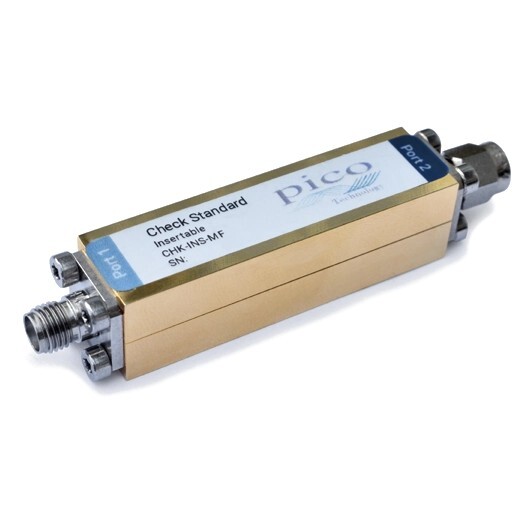
CHK-INS-MF Insertable check standard SMA(m-f)
Precision You Can Trust
NABL-Accredited Calibration | Available on Request
The TA430 CHK-INS-MF is an insertable VNA check standard designed to verify network analyser measurement accuracy after calibration. It uses a 75 mm, 25 Ω mismatched transmission line with SMA female and SMA male ports, covering 300 kHz to 8.5 GHz. The standard supports S11, S21, S12 and S22 verification and is supplied with traceable Touchstone reference data for PicoVNA and compatible third-party VNA measurement checks..
- Detail
- Special Features
- Specification
The TA430 CHK-INS-MF Insertable Check Standard is designed for engineers, RF laboratories, production facilities, research teams and calibration-controlled environments that need an independent way to confirm whether a calibrated vector network analyser setup is producing reliable results.
Unlike a SOLT calibration kit, the TA430 is used after or around the calibration process to verify the resulting measurement setup. It provides a known, deliberately mismatched RF network whose measured S-parameters can be compared against traceable reference data.
The device combines:
- One SMA female RF port
- One SMA male RF port
- Insertable male-to-female configuration
- 75 mm mismatched transmission line
- Nominal line impedance of 25 Ω
- 300 kHz to 8.5 GHz characterised range
- Full S-parameter verification
- Insertable 12-term calibration compatibility
- Traceable Touchstone data
- USB memory containing measurement data
Insertable Male-to-Female Configuration
The TA430 is specifically designed as an insertable check standard.
Its connector arrangement is:
- Port 1: SMA female
- Port 2: SMA male
This allows the standard to be inserted directly between complementary male and female test interfaces without requiring an additional gender-changing adaptor.
That makes it suitable for:
- Male-to-female DUT setups
- Insertable two-port devices
- Filter and attenuator verification chains
- Amplifier measurement setups
- Cable assemblies
- RF modules with complementary connector genders
- Insertable 12-term VNA calibration configurations
The insertable construction helps reduce extra adaptors that could otherwise introduce additional mismatch, loss or phase error.
75 mm, 25 Ω Mismatched Transmission Line
The TA430 is formed from a 75 mm section of 25 Ω mismatched line.
A 25 Ω line connected into a nominal 50 Ω VNA system creates a controlled and predictable impedance mismatch.
This produces measurable:
- Reflection
- Transmission loss
- Phase shift
- Frequency-dependent mismatch
- Smith chart movement
The response is intentionally more demanding than a simple low-loss through connection.
This makes the TA430 useful for checking whether the complete measurement system can accurately measure a network with substantial and changing mismatch across frequency.
300 kHz to 8.5 GHz Frequency Coverage
The TA430 is characterised from:
- 300 kHz
- Up to 8.5 GHz
This range spans the operating range of current PicoVNA 106 and PicoVNA 108 systems.
Typical applications include verification of measurements involving:
- RF filters
- Amplifiers
- Antennas
- Cables
- Connectors
- Couplers
- Splitters
- Attenuators
- Wireless modules
- PCB transmission lines
- Matching networks
- Telecom and RF components
Full S-Parameter Verification
The TA430 supports verification of all four two-port S-parameters:
- S11 input reflection
- S21 forward transmission
- S12 reverse transmission
- S22 output reflection
This allows the user to evaluate both reflection and transmission accuracy in the forward and reverse directions.
The measured data can also be displayed as:
- Return loss
- Insertion loss
- Magnitude
- Phase
- VSWR
- Smith chart
- Polar plot
- Real and imaginary response
Designed for Measurement Validation, Not Calibration
This distinction is important for the RevineTech product page.
The TA430 does not perform SOLT calibration.
Instead, the normal workflow is:
- Calibrate the VNA using a suitable calibration kit.
- Connect the TA430 check standard.
- Measure its S-parameters.
- Load the supplied reference Touchstone data.
- Compare the live measurement with the traceable reference.
- Confirm that the result falls within expected uncertainty.
A calibration kit creates the error correction.
The TA430 checks whether the calibrated VNA, cables, connectors and reference planes are working together correctly.
Insertable 12-Term Calibration Support
Pico states that the TA430 supports all S-parameters and insertable 12-term calibration mode.
A 12-term two-port error model compensates systematic measurement errors in both forward and reverse directions.
The TA430 is well suited to validating such a calibrated setup because its male-to-female configuration is naturally insertable between the two calibrated reference planes.
Traceable Touchstone Measurement Data
Each TA430 is supplied with Touchstone measurement data on USB memory.
Pico states that the data is traceable through PC3.5 standards to national standards.
The Touchstone file can be used to compare:
- S11
- S21
- S12
- S22
- Magnitude
- Phase
This supports:
- Measurement assurance
- Calibration verification
- Quality-controlled RF measurements
- Laboratory procedures
- Production validation
- Research documentation
Compatible with Other VNA Brands
The supplied Touchstone reference data is not restricted only to PicoVNA systems.
Pico states that it can be used to manually validate measurements made with any manufacturer’s VNA, provided that the analyser supports compatible S-parameter and Touchstone workflows.
This makes the TA430 useful in mixed-instrument laboratories.
PicoVNA Comparison Utility
PicoVNA software includes a comparison utility that evaluates the measured check-standard response against the expected reference and a combination of measurement uncertainties from:
- The check standard
- Test leads
- Vector network analyser
This helps users assess whether the result is within the expected measurement limits.
Return-Loss Behaviour
The official specification shows a deliberately varying mismatch across the operating range.
Published return-loss behaviour extends approximately from:
- Less than −30 dB
- To greater than −6 dB
This wide variation is intentional and makes the TA430 more useful as a verification device than a simple matched through.
Insertion-Loss Behaviour
Published insertion loss varies approximately from:
- Greater than −0.2 dB
- To less than −1.9 dB
The precise value changes with frequency because the device is a mismatched transmission line rather than a flat attenuator.
Why a Mismatched Check Standard Is Useful
A perfectly matched through connection can sometimes make a VNA setup appear better than it really is.
The TA430 deliberately introduces:
- Significant mismatch
- Frequency-varying reflection
- Frequency-varying transmission
- Phase variation
This provides a stronger verification of:
- Directivity correction
- Source match
- Load match
- Reflection tracking
- Transmission tracking
- Cable stability
- Connector repeatability
- Calibration reference-plane accuracy
Typical Validation Workflow
A practical TA430 verification procedure includes:
- Allow the VNA, test cables and TA430 to stabilise.
- Inspect and clean all SMA connectors.
- Perform the required VNA calibration.
- Keep the calibrated cables in the same position.
- Connect the TA430 between the two reference planes.
- Apply correct connector torque.
- Measure S11, S21, S12 and S22.
- Load the supplied Touchstone reference file.
- Compare the live and reference traces.
- Review any deviation against expected uncertainty.
- Investigate cable movement, connector condition or calibration errors if the result is outside the expected limits.
Suitable for PicoVNA 106 and PicoVNA 108
The TA430’s 8.5 GHz bandwidth covers the complete measurement range of:
- PicoVNA 106
- PicoVNA 108
This makes it useful as a routine verification standard for PicoVNA laboratories and production test systems.
Applications
The TA430 is suitable for:
- VNA calibration verification
- RF laboratory measurement assurance
- Filter test validation
- Amplifier measurement verification
- Antenna measurement checks
- Cable and connector analysis
- PCB transmission-line testing
- Production RF test verification
- Telecom component testing
- Wireless product development
- Research laboratories
- University RF laboratories
- Network metrology
- Measurement-system troubleshooting
Why Buy from RevineTech?
RevineTech can supply the TA430 insertable check standard for PicoVNA and compatible VNA measurement environments.
Technical support can include:
- TA430 selection
- TA430 versus TA431 comparison
- PicoVNA 106 or 108 compatibility
- SOLT calibration-kit selection
- RF test-lead selection
- Torque-wrench selection
- Touchstone data workflow
- Measurement verification setup
- Recalibration coordination
The TA430 combines several features that make it useful for routine VNA verification:
- Insertable SMA male-to-female configuration
- 75 mm mismatched transmission line
- 25 Ω nominal line impedance
- 300 kHz to 8.5 GHz characterisation
- S11, S21, S12 and S22 verification
- Insertable 12-term calibration support
- Predictable varying mismatch and transmission response
- Traceable Touchstone measurement data
- USB memory data delivery
- Compatibility with PicoVNA and other VNA brands
| Specification | Details |
|---|---|
| Product name | CHK-INS-MF Insertable Check Standard SMA(m-f) |
| Pico product code | TA430 |
| Product type | Insertable VNA check standard |
| Primary purpose | Verification of VNA calibration and measurement setup |
| Connector configuration | SMA female to SMA male |
| Port 1 | SMA female |
| Port 2 | SMA male |
| Nominal line impedance | 25 Ω |
| Mismatched-line length | 75 mm |
| Characterised frequency range | 300 kHz to 8.5 GHz |
| Nominal VNA system impedance | 50 Ω |
| Supported S-parameters | S11, S21, S12, S22 |
| Calibration-mode compatibility | Insertable 12-term |
| Reference data | Touchstone |
| Data delivery | USB memory |
| Traceability | Via PC3.5 standards to national standards |
| PicoVNA compatibility | PicoVNA 106 and PicoVNA 108 |
| Third-party VNA validation | Supported with compatible Touchstone workflow |
RF Performance
| Parameter | Published Behaviour |
|---|---|
| Frequency range | 0.3 MHz to 8500 MHz |
| Return loss | Approximately < −30 dB to > −6 dB |
| Insertion loss | Approximately > −0.2 dB to < −1.9 dB |
| Line construction | 75 mm of 25 Ω mismatched transmission line |
| Port impedance | 25 Ω transmission section |